See You Image License (Matthew 25:35-40)
See You Image License (Matthew 25:35-40)
DIGITAL DOWNLOAD FOR ONE-TIME LICENSE
Interested in licensing a single image for worship or ministry use? This one-time license grants you permission to use this image for ministry purposes. Print the image as bulletin cover art or project the art and engage with it during worship, Sunday School, or Youth Group. We hope you might use our images as tools for spiritual formation.
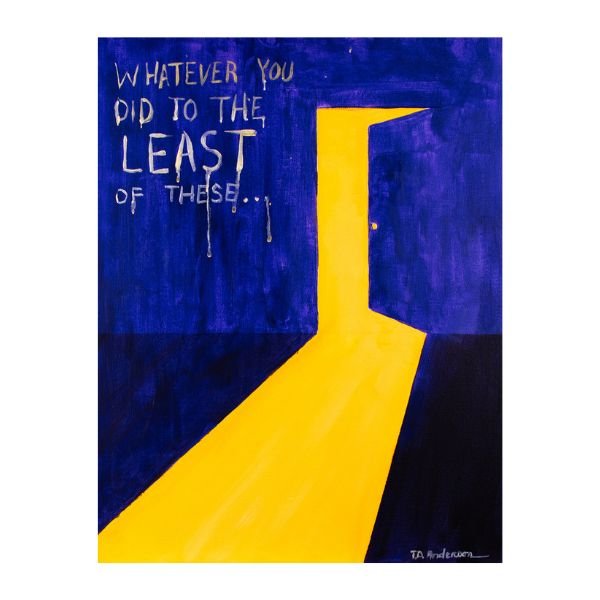
See You
Acrylic on canvas
By T. Denise Anderson
Inspired by Matthew 25:35-40
From our Tell Me Something Good Lent 2026 collection.
Order includes:
high-res image file formatted for print
high-res image file formatted for web/projection
A PDF of the artist's statement & scripture reference for the visual
A visio divina Bible Study Guide for you to use this image in a group study session that incorporates the ancient Benedictine spiritual practice of "divine seeing."
Credit info:
When printing and sharing online, please always include the following credits:
Artist's name | A Sanctified Art LLC | sanctifiedart.org
From the artist:
Throughout Matthew’s Gospel, Jesus uses diminutive language to refer to people of importance and describes small, humble things (like sheep, lilies, and sparrows) as precious. He uses a mustard seed in a parable about faith, and tells his disciples to be like children. For Matthew’s Jesus, little is a big deal!
For that reason, we should pay attention to Jesus’ use of the word “least” in this text. In a book where Jesus talks about little things being loved, the word “least” here takes on new meaning: most loved. Indeed, God loves everyone, but there are certainly those for whom God has a special affinity. As the Confession of Belhar states, “God is in a special way the God of the destitute, the poor, and the wronged.”
As I meditated on this scripture, the image of a doorway kept emerging, perhaps because the text wrestles with the notion of who is in and who is out. This piece shows an excerpt of the text and the word “least” is, ironically, the largest. Next to it is a door that is partially open, and there is some ambiguity intended in that. Is the door being opened or closed? For whom is the door opening or closing? From the viewer’s perspective, on what “side” of the door do they find themselves? Are they being invited in or kept out? Are they doing the inviting or the excluding? In the same way Jesus asks the nations to consider where they will be in his eschatological vision, I invite the viewer to consider where they are relative to where God is. Where does the Savior see you? Where does your neighbor see you?
—Rev. T. Denise Anderson